

The collapse in the cost of artificial intelligence has not removed economic scarcity; it has moved it. When a capable model can be rented for a few cents, the advantage no longer goes to those who know how to plug it in, but to those who control a bottleneck: proprietary data, the trust of a demanding buyer, a place in a critical process, the ability to execute on the ground. This article is for entrepreneurs who want to know where that shift opens real opportunities, and on what conditions.
7 cents
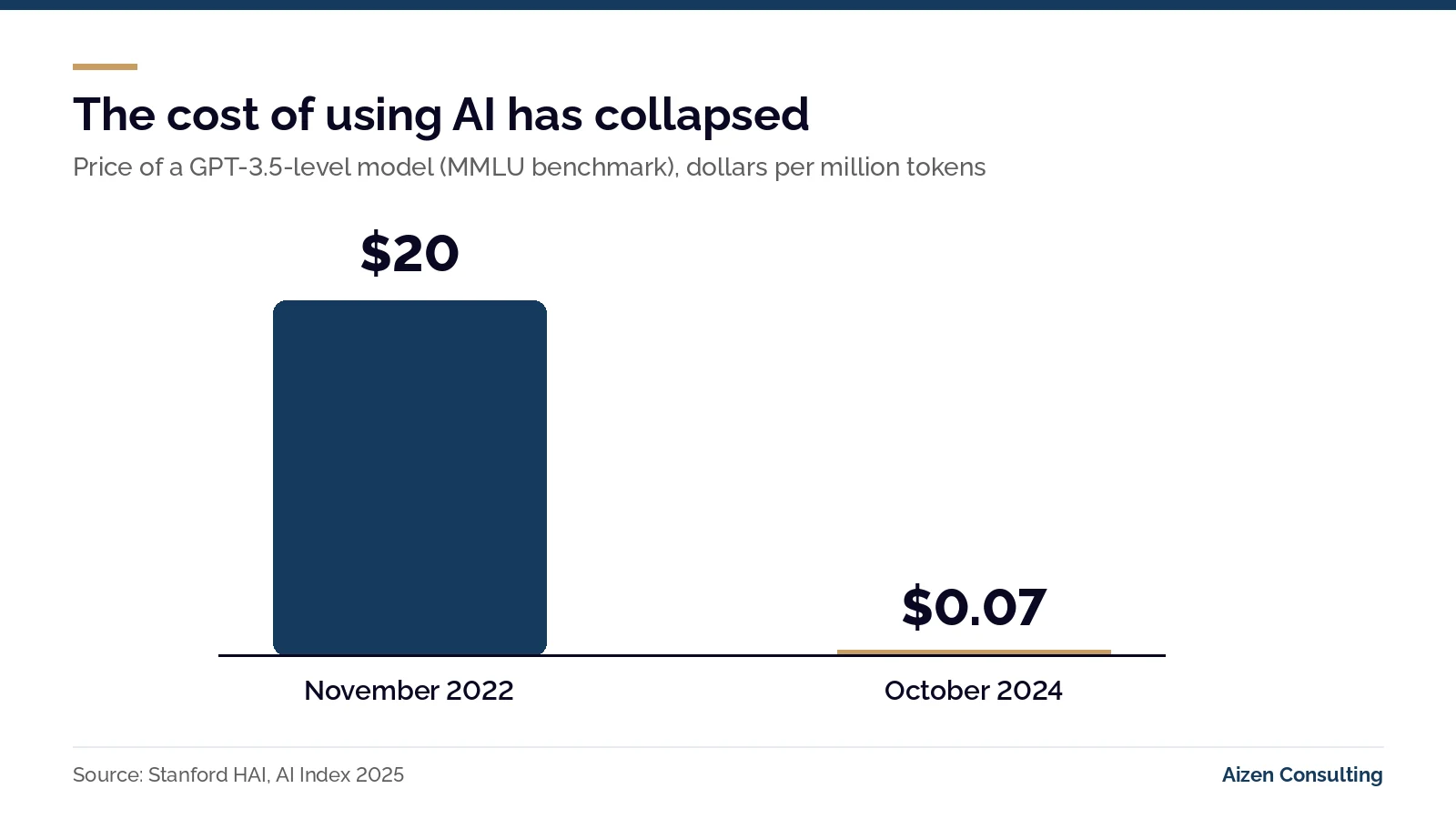
per million tokens in October 2024, down from $20 in November 2022 (Stanford HAI)
61%
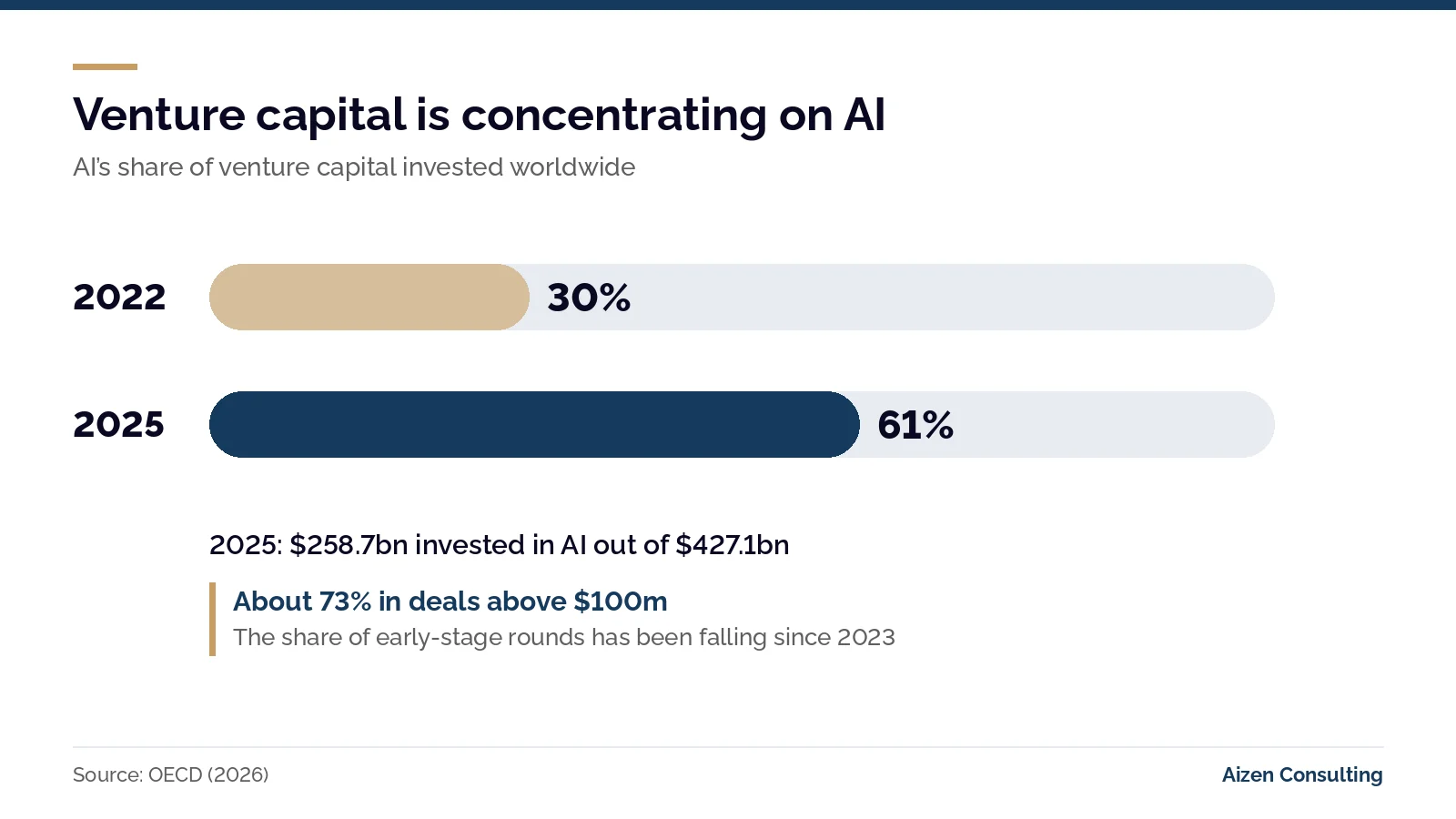
of global venture capital invested in AI in 2025, against 30 per cent in 2022 (OECD)
11.5 months
median time for the top 100 AI companies on Stripe to reach $1 million in annualised revenue
37%
of McKinsey respondents report a positive effect on operating profit
Cheaper technology, more concentrated capital
Building with AI keeps getting cheaper. According to Stanford’s AI Index 2025, the price of using models that match GPT-3.5 on the MMLU benchmark fell from $20 to 7 cents per million tokens between November 2022 and October 2024. A capability that was beyond a small firm’s reach in 2022 now fits a start-up budget.
Financing a young AI company, by contrast, has not become easier. The OECD puts venture capital invested in AI at $258.7 billion in 2025, or 61 per cent of the $427.1 billion invested worldwide, against 30 per cent in 2022. But deals above $100 million account for about 73 per cent of that, and the share of early-stage rounds has been falling since 2023 (OECD). Overall, global corporate investment in AI more than doubled in 2025 to $581.7 billion (AI Index 2026).
For an entrepreneur, the consequence is direct: capital is flowing to a few players, not to most projects. Frugal business models that generate revenue early have an edge. The best young firms show it can be done: the top 100 AI companies on Stripe reached $1 million in annualised revenue in a median of 11.5 months. These are, however, the top performers on the platform, not the sector as a whole.
What the research establishes
The most robust controlled studies agree on one point: AI creates value on some tasks, for some users, in some organisations. They diverge as soon as one steps outside that scope.
| Study | Setting | Result |
|---|---|---|
| Brynjolfsson, Li and Raymond, Quarterly Journal of Economics, 2025 | 5,172 customer support agents | +15 per cent issues resolved per hour, mostly among less experienced agents; slight fall in quality among the most experienced |
| Noy and Zhang, Science, 2023 | 453 professionals, writing tasks | −40 per cent time, +18 per cent quality |
| Dell’Acqua et al., Organization Science, 2026 | 758 Boston Consulting Group consultants | About 25 per cent faster on tasks within the tool’s reach; correct answers down from 84.5 to 70.6 per cent on a task beyond it |
| Becker et al., METR, 2025 | 16 experienced developers, 246 real tasks | +19 per cent time with early-2025 tools, although participants believed they had saved 20 per cent |
At the scale of an economy, Daron Acemoglu, winner of the 2024 Nobel prize in economics, estimates under his assumptions that US total factor productivity will gain no more than 0.66 per cent over ten years (Economic Policy, 2025). Other work is more optimistic; none finds a uniform effect.
For an entrepreneur, these findings have three practical consequences. A solution’s value depends on the line of work it serves, not on the power of the model. Gains are often largest among the least experienced users, which should shape commercial targeting. And perceived gains are not measured gains: an offer that proves its effect on the client’s own data sells better than a promise.
Clients: uneven adoption, and therefore a market
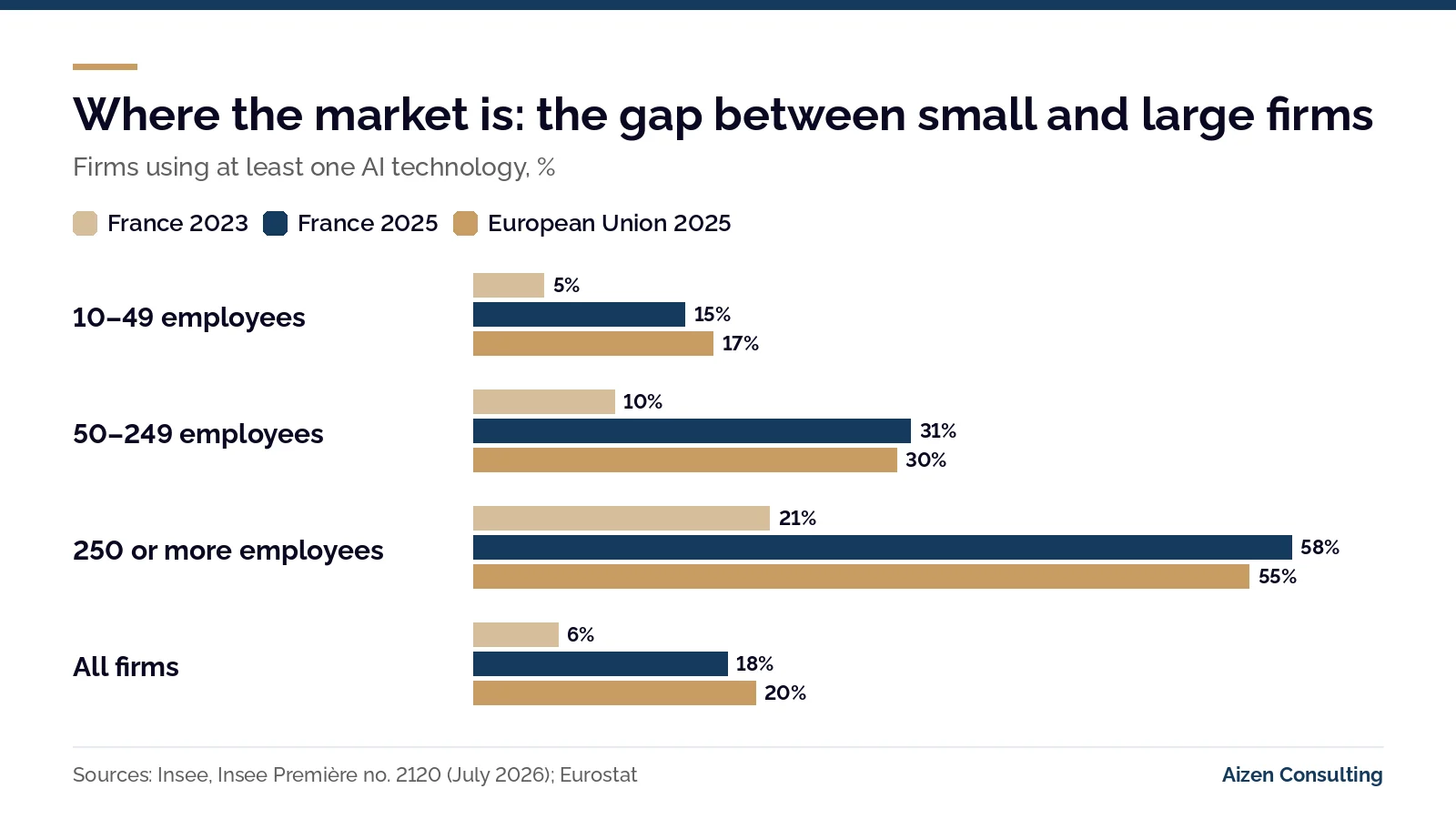
Which leaves the question of who buys. In 2025, 20 per cent of EU enterprises with 10 or more employees, in the sectors covered by the survey, used AI: 17 per cent of small firms, 30 per cent of medium-sized firms and 55 per cent of large ones (Eurostat). In France, the share rose from 10 per cent in 2024 to 18 per cent in 2025 (Insee).
View the chart data
| Firm size | France 2023 | France 2025 | European Union 2025 |
|---|---|---|---|
| 10–49 employees | 5 | 15 | 17 |
| 50–249 employees | 10 | 31 | 30 |
| 250 or more employees | 21 | 58 | 55 |
| All firms | 6 | 18 | 20 |
Source: Insee, Insee Première no. 2120 (July 2026), and Eurostat · firms with 10 or more employees, mainly market sectors excluding agriculture and finance
Adoption does not guarantee results. Nearly 90 per cent of respondents to McKinsey’s 2026 survey report regular use of AI, but only 37 per cent report a positive effect on their organisation’s operating profit. About 6 per cent meet both criteria McKinsey uses for its ʻhigh performers’: at least 5 per cent of operating profit attributed to AI and value creation judged significant. AI agents are being scaled in 40 per cent of organisations with more than $1 billion in revenue, against 22 per cent of smaller ones.
A preliminary study by MIT’s NANDA project, based on a limited sample, points the same way: most of the generative AI projects it examined have yet to show a measurable effect on profit and loss, and those run with a specialist vendor reach deployment more often, roughly two times in three against one in three for in-house builds (MIT NANDA). These are deployment rates, not proof of profitability. Conversely, nearly half of McKinsey’s high performers have decided against buying at least one software product or feature in order to build it in-house with AI assistance, against 31 per cent of other respondents.
For an entrepreneur, the reading is twofold. The gap between small and large firms is a market: integration, training, ready-to-use solutions. But the most advanced clients increasingly build for themselves. Lasting value therefore lies where the client cannot easily replace the supplier: sector knowledge, integration with data, maintenance and accountability for the outcome.
Two ways to grow with AI
Two kinds of company are profiting from this gap: those that sell AI, and those that use it to do an existing job better. Comparing them means reading their figures with care, because the examples often mix five indicators that measure different things: annualised recurring revenue (ARR), usually the latest month’s revenue multiplied by twelve; accounting revenue; capital raised; valuation; and profit. A company can show spectacular ARR, a high valuation and losses. The tables below state the nature of each figure.
AI vendors
| Company | Activity | Published indicator and nature of the data | Capital |
|---|---|---|---|
| Lovable (Stockholm, 2023) | App building in plain language | $200m ARR in November 2025, $400m in February 2026 with 146 employees, or about $2.7m per employee · reported ARR (TechCrunch) | Valued at $13.3bn in August 2026 (VKTR) |
| Emergent (Bengaluru and San Francisco, 2024) | Apps for non-developers and small businesses | From $50m to $100m ARR in one month, February 2026 · reported ARR (TechCrunch) | $130m raised at a $1.5bn valuation in July 2026 (Emergent) |
| Mistral AI (Paris, 2023) | AI models and platforms for companies and governments | Over $400m annualised in early 2026 · chief executive’s statement to the press, not broken down in published accounts (TechCrunch) | €3bn raised at a valuation above €21bn in September 2026, led by Samsung (Mistral AI); Nvidia took part; ASML the largest shareholder since the 2025 Series C |
| ElevenLabs (London and New York, 2022) | Synthetic voice and voice agents | From $350m ARR at end-2025 to over $500m four months later · reported ARR (SiliconANGLE) | Valued at $11bn in February 2026 (Reuters via The Star) |
| Legora (Stockholm, 2023) | AI agents for law firms and in-house legal teams | From $100m to over $200m ARR in under six months, October 2026 · reported ARR (City AM) | Valued at $8.8bn; Nvidia a shareholder since April 2026 (TNW) |
| Sierra (San Francisco, 2023) | Customer service agents for large enterprises | Over $400m ARR at end-October 2026, against $200m five months earlier · reported ARR (Sierra) | Valued at over $15bn in May 2026 (SiliconANGLE); a new round at about $30bn under negotiation according to The Information, not closed as of 27 November 2026 (Value Add VC) |
| OpenEvidence (Miami, 2021) | Clinical decision support, funded by advertising | Over $100m annualised in 2025 according to its chief executive (HLTH); about $300m in July 2026 according to an external estimate (Sacra) | Valued at $12bn in January 2026 |
| Cursor (San Francisco, 2022) | Coding assistant for developers | Over $2bn annualised in February 2026 · anonymous source quoted in the press (Bloomberg) | A SpaceX subsidiary since 14 August 2026, after a $60bn all-stock acquisition (Bloomberg Government) |
| Company | Reported ARR ($m) |
|---|---|
| ElevenLabs | 500 |
| Lovable | 400 |
| Sierra | 400 |
| Legora | 200 |
| Emergent | 120 |
Latest value of each series; the original chart traces the trend from July 2025 to October 2026.
Sources: company announcements and blogs (Lovable, Sierra, ElevenLabs, Legora, Emergent), reported by TechCrunch, SiliconANGLE, City AM and Inc42 · July 2025 to October 2026 · self-reported, unaudited figures
Backing from a large group: what it brings, what it costs
A legally independent company is not always financially independent. Mistral AI’s last two rounds were led by industrial groups. ASML invested €1.3bn in the September 2025 Series C, for about 11 per cent of the fully diluted capital, a seat on the strategic committee and a long-term agreement to use AI across its products, research and operations (ASML). Samsung led the €3bn Series D in September 2026, with Nvidia taking part (TechCrunch). Nvidia has also invested in Legora, and Cursor is now a SpaceX subsidiary.
For a founder, backing from a large group is a trade, not just another source of funding.
| What the group brings | Example | What to negotiate in return |
|---|---|---|
| Co-development: real use cases, engineers, a test bed | AI models built into ASML’s lithography systems | Ownership of jointly developed intellectual property |
| Market access: customers, sales network, credibility with large accounts | ASML, Airbus and HSBC are among Mistral AI’s customers (StorageNewsletter) | Sector or geographic exclusivity |
| Computing power: access to chips and data centres | Mistral AI runs Nvidia systems, supplied by one of its shareholders | Dependence on a single supplier |
| Proprietary data to train and validate models | The ASML–Mistral AI agreement covers ASML’s R&D and operations | Usage rights, confidentiality, data portability |
| Patient capital and large cheques | €1.3bn from ASML in a single round | A seat on the strategic committee or board, vetoes, pre-emption rights |
Our recommendation: accept the industrial investor for what it alone can bring, and negotiate from the first round the terms that keep future options open, notably no blanket exclusivity, limited pre-emption rights and data portability. A buyer that competes with the industrial shareholder will think twice before acquiring the company, and that constraint is paid for at exit.
Traditional companies transformed by AI
The second model is more accessible: using AI to run an existing business better. Listed companies publish audited accounts, which makes it possible to separate growth from profitability.
| Company | Business | Revenue | Profitability |
|---|---|---|---|
| Tempus AI (Chicago) | Precision medicine: diagnostic tests and clinical data | $1.27bn in 2025, against $693.4m in 2024 (+83 per cent, including about 30 per cent organic growth excluding the Ambry Genetics acquisition) (GenomeWeb) | Net loss of $245m in 2025 (Quartr) |
| Lunit (Seoul) | Medical image analysis and AI-assisted cancer detection | KRW 83.1bn in 2025 (+53 per cent), 92 per cent of it abroad (Lunit) | Operating loss of KRW 83.1bn, the same amount as revenue (loss-to-revenue ratio down from 1.25 to 1.0); net loss of KRW 47.4bn (Dailymedi) |
| Lemonade (New York) | AI-driven home, car and pet insurance | $737.9m in 2025 (+40 per cent) (Nasdaq) | Net loss of $2.24 per share; adjusted EBITDA of −$118.1m |
| Insider One (Istanbul, 2012) | Predictive marketing and customer engagement | Not published; more than 1,500 customers in 28 countries and a $500m round led by General Atlantic in 2024 (General Atlantic) | Not published |
These trajectories show commercial growth, but they do not allow all of it to be attributed to AI, and none of these companies was profitable in 2025. For an entrepreneur, the lesson concerns the model: AI creates an advantage when it rests on an asset that is hard to replicate, such as clinical data, a book of policyholders or a loyal customer base.
Where to start a business
The question, then, is not which sector is “adopting AI”, but where a new entrant starts with an advantage. The large platforms target mass markets. Many needs escape them: markets too narrow, too regulated, or too dependent on local selling or bespoke integration to deliver the returns they seek. That is where an entrepreneur has an edge, provided they hold what the giant lacks.
| Sector | Opportunities to assess | Decisive asset for a new entrant |
|---|---|---|
| Manufacturing | Predictive maintenance, visual quality control, production optimisation | Access to machine data and process knowledge |
| Construction and real estate | Automated quantity take-off, cost estimating, tender analysis | Price libraries and a network of project owners |
| International trade | Document analysis, sourcing, customs compliance, technical translation | Knowledge of regulations and trade corridors |
| Logistics | Route optimisation, inventory forecasting, delivery planning | Integration with existing transport and warehouse systems |
| Agriculture | Disease detection, irrigation management, yield forecasting | Local data and access to farmers |
| Health | Clinical documentation, decision support, administration | Clinical validation and regulatory compliance |
| Finance and insurance | Anomaly detection, claims and file processing, risk analysis | Licences, historical data, regulators’ trust |
| Recruitment | Skills-to-job matching, skills mapping, administrative automation | Compliance expertise: the EU AI Act classes these uses as high-risk |
| Energy | Consumption forecasting, plant optimisation | Access to metering data |
| Education and training | Personalised pathways, adaptive learning | Validated content and referrers (schools, employers) |
| Cybersecurity | Threat detection, incident analysis, automated audit | Scarce expertise and client references |
| Services for small firms | AI integration, process automation, training | Proximity, speed of delivery, controlled cost |
These are leads to validate commercially, not guarantees of profitability. What they share: the advantage comes from the line of work, the data or access to the client, rarely from the technology itself.
Choosing a business model
Once the ground is chosen, the question is how to make money on it. The model determines how much capital is needed, how quickly the company can live off its revenue and how defensible its position is.
| Model | Capital intensity (indicative) | Revenue | Barriers to entry | Key risk |
|---|---|---|---|---|
| AI consulting and integration | Low | Fees, maintenance contracts | Low: reputation and references | Growth capped by headcount |
| Vertical software for one line of work | Medium | Subscriptions, usage-based pricing | Medium: domain expertise, integrations, data | Customer acquisition cost and inference cost |
| Outsourced automation | Low to medium | Per file processed or per outcome | Medium: quality of execution | Accountability for the outcome delivered |
| Traditional business augmented by AI | Variable | Better margins, new services | Those of the sector: licences, assets, customer base | Capital needs of the underlying business |
| AI governance and compliance | Low to medium | Audits, advisory, specialist software | Medium: combined legal and technical expertise | Dependence on the regulatory timetable |
| Infrastructure and foundation models | Very high | Licences, APIs, consumption | Very high: capital, talent, compute | Out of reach for most entrepreneurs |
Four parameters decide viability:
- Inference cost. Every query carries a computing cost that weighs on gross margin. Sacra estimated Lovable’s at 36 per cent in May 2025, with a target of 65 per cent (Sacra), well below usual software levels.
- Customer acquisition cost. It must be set against customer lifetime; an offer that is easy to copy is paid for in discounts and sales spend.
- Retention. A client who expands usage funds growth: Tempus reports net revenue retention of 126 per cent at end-2025 (Quartr).
- Funding needs. With venture capital concentrated in large deals, a model that becomes self-financing early is safer.
Pricing can also become an advantage. Sierra charges for its agents by outcome achieved, such as a claim settled or a customer retained, rather than per seat (ARR Club, citing Sierra). The model ties price to value created, which makes it easier to sell to a sceptical client.
The international map
The same reasoning holds from one country to the next: AI is available everywhere, the conditions for earning a living from it are not. Three notions are often confused: job exposure to AI, available infrastructure and speed of adoption. The IMF puts potential job exposure at about 60 per cent in advanced economies, 40 per cent in emerging markets and 26 per cent in low-income countries. These figures measure the share of jobs whose tasks could be affected, not job losses or how fast firms will adopt AI.
The World Bank supplies the missing piece. Its World Development Report 2026 argues that AI could let developing countries do in a decade what might otherwise take a century, provided they close gaps in power, connectivity, skills and institutional quality. It recommends adopting existing tools, adapting them to local conditions, and only then advancing towards the frontier. Its 2025 report sums up these conditions as four foundations: connectivity, compute, context (data and applications suited to local needs) and competency (World Bank).
| Region | Priority opportunities to study | Conditions to check |
|---|---|---|
| Europe | Industrial AI, technological sovereignty, compliance, automation for small firms | EU AI Act; early-stage funding scarcer than in the United States |
| Turkey | Manufacturing, exports, construction, digital services | Export-oriented industrial base; Insider One shows an Istanbul-born platform can succeed internationally |
| Africa | Agriculture, financial inclusion, education, health, accessible multilingual solutions | Energy and connectivity; funding still very limited |
| Middle East | Construction, energy, public services, business automation | Weight of public procurement and local partnerships |
| India | IT services, automation of outsourced processes, vertical software | Depth of the engineering pool; Emergent serves 190 countries from Bengaluru and San Francisco |
| Latin America | Fintech, agriculture, retail and logistics | Macroeconomic volatility and local currencies |
| North America | Vertical software, health, cybersecurity, advanced automation | The deepest market, but also the most competitive and expensive |
Africa illustrates the gap between potential and means. TechCabal Insights’ census counts 207 young companies with AI at the core of their business in 2025, against 104 in 2022, without claiming to cover the whole market (TechCabal Insights). The deals tracked by Intelpoint brought African AI start-ups just $37.8 million in 2025 (Intelpoint). For an entrepreneur able to bring together capital and commercial partners, the field remains wide open.
Risks to build into the business plan
Four risks deserve a line in any business plan.
Platform dependence. An application built on a third party’s model may see that third party become its competitor. In April 2026, OpenAI launched a free service for doctors that competes directly with OpenEvidence (Sacra). Defences exist, and they add up: proprietary data, control of distribution, sector know-how, switching costs for the client, intellectual property.
The illusion of a head start. Being first in a market brings customers and data, but does not secure the position. Legora, founded a year after Harvey, has passed $200 million in annualised revenue competing head-on with it; Cursor, one of the leaders in AI-assisted coding, ended up being acquired.
Valuations are not results. Some valuation multiples exceed 50 times estimated revenue (AI Magazine), whereas a conventional software company typically aims for ten times recurring revenue (Bloomberg Law). A prudent business plan does not rely on these benchmarks.
Regulation. The EU AI Act imposes stricter obligations on high-risk uses, including recruitment and access to certain essential services. Built in from the design stage, compliance becomes a selling point; discovered late, it is expensive.
The entrepreneur’s roadmap
- Choose a line of work before a technology. Start from a sector you know, where you have access to clients and data. That is the barrier cheaper AI does not remove.
- Test the task on real cases. AI excels at some tasks and fails at others of similar difficulty. Measure the gain on the client’s data, not on users’ impressions.
- Build unit economics from day one. Inference cost per client, gross margin, acquisition cost, payback period: these numbers matter more than a growth curve.
- Organise your defences. Own data, integration into the client’s processes, distribution channels, switching costs: aim to combine at least two as early as possible.
- Fund frugally. Aim for early self-financing, and, with an industrial investor, use the negotiating grid set out above.
- Go international market by market. Language, regulation, data hosting and sales channels must be prepared country by country. Adapting an existing tool to local conditions is often more profitable than building your own.
AI makes technology available to everyone. In doing so, it raises the value of what cannot be downloaded: knowledge of a market, the trust of clients and the ability to execute.
Aizen Consulting, business advisory and international development.
Assessing an AI-related opportunity in a new market? Describe your project in a few lines.
Bibliography
Scientific publications and research papers
- Acemoglu, D. (2025). The simple macroeconomics of AI. Economic Policy, 40(121), 13–58. Peer-reviewed. doi:10.1093/epolic/eiae042
- Becker, J., Rush, N., Barnes, B. and Rein, D. (2025). Measuring the Impact of Early-2025 AI on Experienced Open-Source Developer Productivity. METR. Working paper. doi:10.48550/arXiv.2507.09089
- Brynjolfsson, E., Li, D. and Raymond, L. (2025). Generative AI at Work. Quarterly Journal of Economics, 140(2), 889–942. Peer-reviewed. doi:10.1093/qje/qjae044
- Challapally, A., Pease, C., Raskar, R. and Chari, P. (2025). The GenAI Divide: State of AI in Business 2025. MIT NANDA. Preliminary study.
- Dell’Acqua, F., McFowland III, E., Mollick, E., Lifshitz-Assaf, H., Kellogg, K. C., Rajendran, S., Krayer, L., Candelon, F. and Lakhani, K. R. (2026). Navigating the Jagged Technological Frontier: Field Experimental Evidence of the Effects of Artificial Intelligence on Knowledge Worker Productivity and Quality. Organization Science, 37(2). Peer-reviewed. doi:10.2139/ssrn.4573321 (working version)
- Noy, S. and Zhang, W. (2023). Experimental evidence on the productivity effects of generative artificial intelligence. Science, 381(6654), 187–192. Peer-reviewed. doi:10.1126/science.adh2586
Institutional sources and surveys
- Cazzaniga, M., Jaumotte, F., Li, L., Melina, G., Panton, A. J., Pizzinelli, C., Rockall, E. and Tavares, M. M. (2024). Gen-AI: Artificial Intelligence and the Future of Work. Staff Discussion Note SDN/2024/001, International Monetary Fund. doi:10.5089/9798400262548.006
- Eurostat (2025). Use of artificial intelligence in enterprises. Eurostat
- Lefebvre, C. (2026). Les technologies de l’information et de la communication dans les entreprises en 2025. Insee Première, no. 2120. Insee
- McKinsey & Company (2026). The state of AI in 2026: On the road to ROI. Survey of 1,719 respondents in 97 countries. McKinsey
- OECD (2026). Venture capital investments in artificial intelligence through 2025. OECD
- Regulation (EU) 2024/1689 of 13 June 2024 laying down harmonised rules on artificial intelligence. EUR-Lex
- Stanford HAI (2025). AI Index Report 2025. Stanford
- Stanford HAI (2026). AI Index Report 2026, chapter 4: Economy. Stanford
- World Bank (2025). Digital Progress and Trends Report 2025: Strengthening AI Foundations. doi:10.1596/978-1-4648-2264-3
- World Bank (2026). World Development Report 2026: The Promise of Artificial Intelligence. doi:10.1596/978-1-4648-2331-2
Primary financial information and official announcements
- ASML (2025). ASML, Mistral AI enter strategic partnership, 9 September 2025. ASML
- Emergent (2026). Emergent Is Now a Unicorn: We Raised $130M in Our Series C at a $1.5B Valuation, 15 July 2026. Emergent
- General Atlantic (2024). Insider Announces $500M Series E Led by General Atlantic, 1 November 2024. General Atlantic
- Lemonade (2026). Q4 2025 Letter to Shareholders, 19 February 2026. Business Wire
- Lunit (2026). Investor Relations Letter, Q1 2026. Lunit
- Mistral AI (2025). Mistral AI raises 1.7B€ to accelerate technological progress with AI, 9 September 2025. Mistral AI
- Mistral AI (2026). Mistral raises €3bn (Series D announcement), 8 September 2026. Mistral AI
- Sierra (2026). Our customers’ ambition is accelerating our growth, 30 October 2026. Sierra
- Stripe (2025). Indexing the AI economy. Stripe
- Tempus AI (2026). Tempus Announces Preliminary Fourth Quarter and Full Year 2025 Results, 11 January 2026. Business Wire
Secondary sources
Used where the primary source was not accessible: Bloomberg, Bloomberg Government and Bloomberg Law; Reuters (via The Star); TechCrunch; SiliconANGLE; City AM; The Next Web; VKTR; HLTH; AI Magazine; GenomeWeb; Nasdaq (Zacks); Quartr; ARR Club; TechCabal Insights; Intelpoint; Dailymedi (Lunit’s annual accounts); StorageNewsletter (Mistral AI press release); The Information, via Value Add VC (Sierra’s negotiations); Sacra (independent estimates, flagged as such in the text). Each source is cited in brackets next to the figure it supports; references with a DOI are linked in the bibliography. All sources last accessed on 27 November 2026.